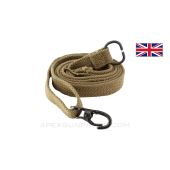
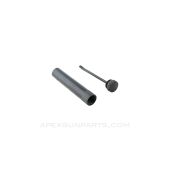
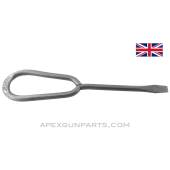
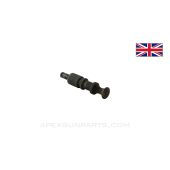
This is a demo store. No orders will be fulfilled.

STEN Mark 3
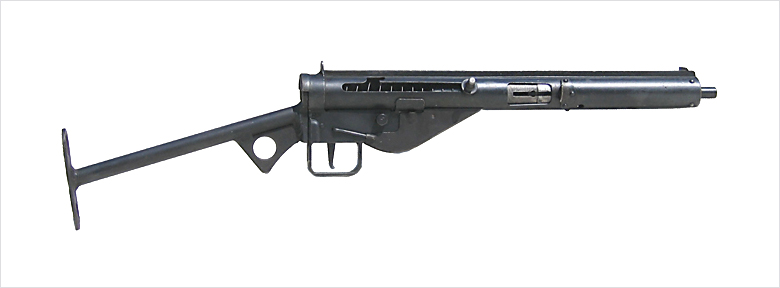
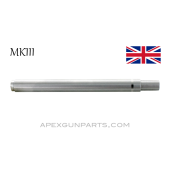
The Lines brothers George and Joseph made wooden toys early in their careers. Joseph had four sons, three of whom formed Lines Bros Ltd soon after WW1. They were William, Walter and Arthur Lines. They branded their specific toy line "Tri-ang Toys". They were know for a variety of toys but specifically toy trains. At the start of the WW2, production of children's toys was deemed non-essential by the British Government. As a result, production facilities were converted to weapons manufacture. The Lines Bros. were tasked specifically with developing the STEN submachine gun. During initial production of the MKII version the Lines Bros. realized the firearm could be simplified due to their extensive knowledge of stamped sheet metal from earlier toy production. In the winter of 1941-1942 the first prototype MKIII's were made. A few problems were prevalent from the start. The first was the number of ejections issues. The second was the top seam of the barrel casing was also found to be too weak. After firing 2,625 rounds the seam above the chamber area opened up slightly. Thirdly the rivets securing the rear barrel support needed to be closer together. The 7/8" spacing was not close enough on the prototype. These were the major issues in the testing phase, and relatively simple problems to have. The ejections issues were fixed by redesigning the finger guard to be out of the way and riveted to the casing. Also the ejection port had been made 1/8'' narrower than the drawing originally showed. This was also fixed. The main problem remaining in the design phase was the weak body seam. This problem was rectified in production. The first production order arrived from the War Office in January of 1942. The order was for 500,000 of the new type of STEN called the MKIII. Training the workforce became the major hurtle at the beginning. Lines set aside five weeks of training of the workers (who were mostly women). When production began the factory implemented a three-shift, 24-hour-a-day operation. Within a year, the 500,000-gun initial order was complete. The Lines Bros. had the production of the MKIII down to 5 1/2 man-hours per gun (the MK1 took 12 man-hours per gun). That total can be visualized as 500 per shift. The success in completing the massive production order boiled down to the Lines Bros. simplification from the MKII to the MKIII. The first major rework was the reduction of the number of parts it takes to complete a submachine gun. The STEN MKII originally had 69 parts in total required to produce it. The Lines Bros. reduced that number to only 48 parts. Further more the MKIII had a few key design changes because of these fewer parts. The MKII had a removeable barrel. With the MKIII the Lines Bros. decided that the barrel and the surrounding shroud should be a single unit (non removeable). This means if the barrel assembly was damaged or not functioning the whole SMG would have to be scrapped instead of fixed. A common problem related to the barrel assembly was over time the repeated firing of the MKIII would eventually break free components of the barrel assembly. This would result in the barrel rotating or spinning freely in its housing. The British military concluded that it was actually more economic to just scrap the entire SMG when problems like this arose, and just issue a brand new MKIII. Another key difference was that the magazine housing was welded into place. Unlike the MKII magazine well housing which could rotate 90 degrees back and forth. The receiver body was also a major change in design. The MKII used a solid metal tube, and the MKIII changed to a flat piece of sheet metal rolled into shape with a mandrel. The top of the MKIII receiver had a rib that was spot welded every quarter inch to keep it in place. The trigger guard was another interesting change. The MKIII had a new trigger guard that incorporated the slot for the stock to interface with. The Lines Bros. received their second contract for another 500,000-guns. And even a third contract for another 500,000-guns in October of that same year, but this contract was eventually cancelled. According to the remaining contract records, the Lines Bros. only produced 376,794 STEN MKIII's of the second contract. Bringing the grand total produced to 876,794. Although official records suggest 876,886. Why there is a discrepancy of 92 guns is still a mystery. So in September 1943 production was halted on the MKIII in favor for the MKII. The remaining MKIII's were sent to the British home guard, the Royal Ulster Constabulary, and other service support units to finish out its service life around the 1990's.